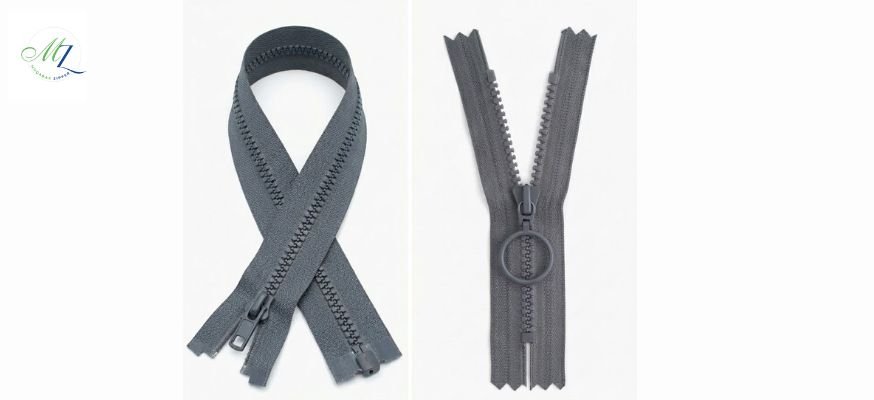
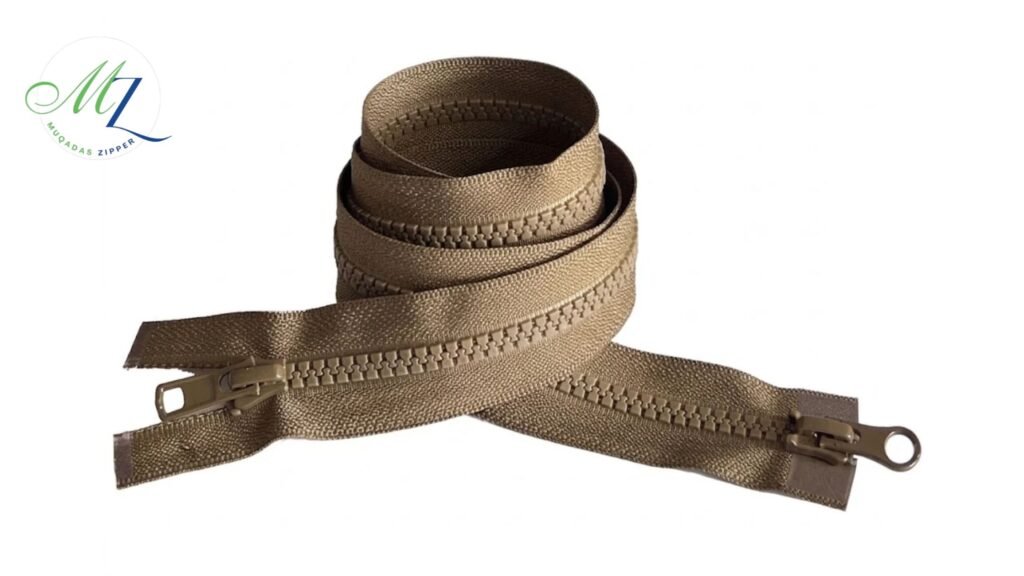
A two-way Vislon zipper puts two sliders on one chain of molded plastic teeth, so you can open a garment from the hem while it stays closed at the chest. For functional clothing, that single change delivers practical benefits: easier movement when the wearer sits, rides or kneels; ventilation without unzipping the whole front; less strain on the hem; quick access to belts, harnesses and inner layers; and all the rust-free, lightweight strengths of molded plastic teeth.
If you develop parkas, workwear, rider jackets or long outdoor coats, this guide shows you how a two-way Vislon zipper works, where it earns its extra cost, where it does not, and exactly what to write on your purchase order.
A note on the name: VISLON® is a registered trademark of YKK Corporation for its molded plastic zippers. In Pakistan’s garment trade, and in this article, “Vislon zipper” describes molded plastic tooth zippers in general.
What Is a Two-Way Vislon Zipper?
A two-way Vislon zipper is a molded plastic zipper fitted with two sliders that travel along the same chain. Each tooth is injection-molded from polyacetal (POM) directly onto the zipper tape, instead of being formed from a continuous coil or stamped from metal. The second slider is what makes it “two-way”: one slider opens and closes the zipper from the top, and the other opens it from the bottom.
You will also hear it called a double-slider plastic zipper. That name is accurate, but it covers two different builds, and choosing the wrong one is a common sampling mistake.
| Configuration | How it is built | Where it fits in clothing |
|---|---|---|
| Two-way separating (open-end) | Two sliders set back to back, plus an insertion pin. The bottom slider holds the pin, so the two sides can separate completely. | Jacket and coat fronts, parkas, coveralls, rider jackets, long vests |
| Two-way closed-end | Two sliders on a chain joined at both ends, so the sides never separate. The sliders often meet head to head. | Leg vents, pit zips, side-seam vents, large cargo pockets |
For functional clothing, “two-way Vislon zipper” almost always means the two-way separating version, so that is the focus of this guide.
How the Two Sliders Work Together
On a standard one-way open-end zipper, the insertion pin slides into a fixed retainer box at the bottom of the chain. On a two-way separating zipper, the bottom slider takes the place of that fixed box. That is why the closing sequence matters:
- Pull the top slider all the way down until it rests on the bottom slider.
- Push the insertion pin fully into the bottom slider, right to the end.
- Hold the pin side and pull the top slider up to close the garment.
- To open from the hem, pull the bottom slider up as far as you need.
If the bottom slider is not seated at the very end of the chain, or the pin is only half inserted, the teeth can misalign and the zipper will not close properly. That detail drives several of the specification choices later in this guide.
Six Benefits of a Two-Way Vislon Zipper in Functional Clothing
1. Freedom of Movement When the Wearer Sits, Rides or Kneels
When someone sits down in a mid-thigh parka with a one-way zipper, the hem has nowhere to go. The fabric bunches across the hips and pulls against the lower teeth. With a two-way zipper, the wearer slides the bottom slider up a few centimetres and the hem opens into a split, much like a coat vent. Drivers, delivery riders, security staff, warehouse operators and anyone who climbs or crouches in a long jacket feel this difference immediately.
2. Ventilation Without Fully Unzipping
Functional clothing has to manage heat as well as weather. A two-way zipper lets the wearer release warm air from below while the chest and collar stay sealed against wind and rain. You gain a second ventilation option without adding pit zips or extra seams to the pattern.
3. Less Strain on the Lower Chain and Hem Seams
When a long jacket is fully closed and the wearer sits or strides, tension gathers at the last few centimetres of the chain and the stitching around the bottom assembly. Opening from below lets the garment flare instead of loading those teeth, which reduces stress at a point that would otherwise take it every time the wearer sits down. Correct sizing still matters more, as you will see below, but the split hem helps.
4. Quick Access to What Is Underneath
In workwear and uniforms, the wearer often needs to reach something beneath the outer layer without exposing the chest to cold: a harness attachment point, a tool belt, a radio, an ID badge or an inner pocket. Opening from the bottom gives that access in seconds and keeps the upper body covered.
5. The Molded-Tooth Advantages Carry Over
Every strength of molded plastic teeth stays in place when you add a second slider:
- Rust-free in rain and sweat. POM teeth do not corrode, so the zipper keeps working on rainwear and outdoor gear. You can read more about how molded teeth handle rain, salt spray and constant moisture.
- Lighter than metal. A long two-way chain on a knee-length coat adds less weight than a comparable metal zipper.
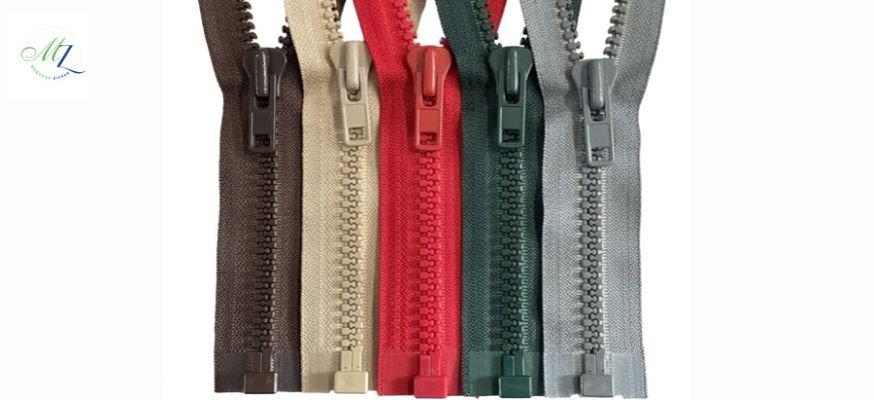
- Colour that lasts. The colour is part of the molding material, so it does not chip or peel off the teeth.
- Grit tolerance. Individual molded teeth shed sand and dirt more readily than a coil, which can trap fine grit in its spiral.
- Glove-friendly operation. Chunky teeth and larger sliders are easier to engage with cold or gloved hands than a fine coil.
6. Design and Branding Flexibility
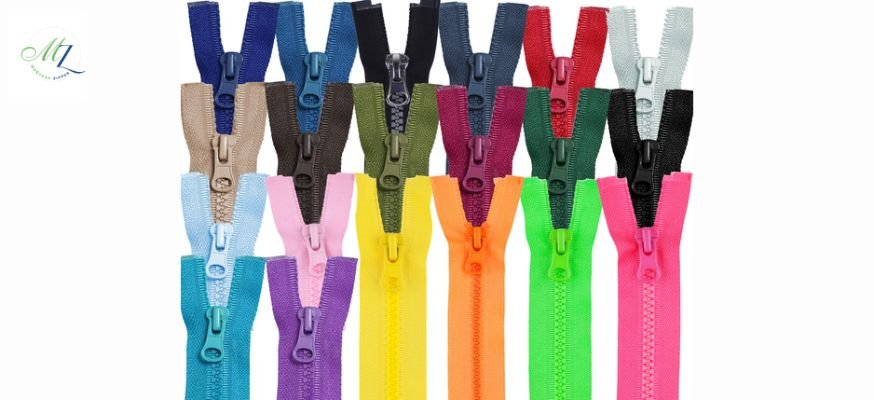
The bold look of molded plastic teeth suits outerwear and sportswear, and you can dye the tape and teeth to match your fabric swatch. Add branded pullers on both sliders and the zipper becomes part of the garment’s identity rather than a hidden component.
Does Your Garment Actually Need a Two-Way Zipper?
A two-way zipper adds a slider, a more complex bottom assembly and some cost per unit, so it should earn its place. Use this simple test: if the wearer will sit, ride, drive, kneel or wear equipment at the hip while the garment is closed, a two-way zipper is worth specifying. If the garment ends at the waist and is mostly worn standing, a one-way open-end zipper is usually enough.
| Garment | Two-way worth it? | Typical size | Why |
|---|---|---|---|
| Hip-length softshell or hoodie | Usually not | #5 | A short hem rarely binds; one slider is simpler to use |
| Mid-thigh or knee-length parka | Yes | #5 or #8 | The hem binds when sitting; a bottom opening restores stride |
| Long winter coat | Yes | #8 | A long chain and heavy fabric benefit most from a split hem |
| Hi-vis or utility workwear jacket | Yes | #5 or #8 | Access to harness, tool belt and radio |
| Rider or delivery jacket | Yes | #5 or #8 | The wearer sits with legs apart, so the hem must open |
| Insulated coverall | Yes | #8 | Long front opening with frequent kneeling and climbing |
| Children’s winter jacket | Often not | #5 | One slider is easier for small hands to engage |
Size matters as much as configuration. A #3 chain on a heavy parka is more likely to pop open under sideways pull, while a #10 can look and feel oversized on a light jacket. For a fuller breakdown by fabric weight and product, see our guide to choosing the right Vislon zipper size and tooth profile.
Two-Way Vislon Zippers vs Other Double-Slider Options
Coil and metal functional clothing zippers also come in two-way versions. Here is how they generally compare.
| Feature | Two-way Vislon (molded plastic) | Two-way nylon coil | Two-way metal |
|---|---|---|---|
| Teeth | Individual POM teeth molded onto tape | Continuous nylon or polyester spiral | Individual metal teeth (brass, aluminium, nickel) |
| Corrosion | Does not rust | Does not rust | Can tarnish or corrode, depending on alloy and finish |
| Weight | Light | Lightest | Heaviest |
| Curved seams | Best on straight or gently curved runs | Best for curves | Best on straight runs |
| Grit and sand | Sheds grit well | Can trap fine grit | Grit can make sliders stick |
| Look | Bold, chunky, colour-molded | Slim, low profile | Classic metal finish |
| Common uses | Parkas, workwear, sportswear, rider jackets | Light jackets, softshells, linings | Denim and leather jackets, fashion outerwear |
If you are making a technical or work jacket with a long, straight front and heavy daily use, a two-way Vislon zipper usually gives you the best balance of strength, weight and weather tolerance.
Limitations to Plan For
- Engagement takes care. Because the bottom slider acts as the retainer, the pin must be fully inserted and the bottom slider fully seated. A hang tag with the closing steps prevents returns that are really user error.
- Higher unit cost. You pay for an extra slider and a more complex bottom assembly, so reserve two-way zippers for garments that pass the test above.
- Not ideal on tight curves. Molded teeth are more rigid than coil, so keep two-way Vislon zippers on straight or gently curved fronts.
- Length must be right the first time. A separating zipper is shortened from the top by removing the top stops, never by cutting off the pin end. Order accurate lengths for every garment size; if you need a method, see how to calculate zipper requirements with your manufacturer.
- Slider choice affects behaviour. A non-locking bottom slider may creep upward when the hem is under tension. On workwear, consider auto-lock sliders at both ends.
How to Specify a Two-Way Vislon Zipper for Production
A clear specification saves you a sampling round. Confirm these eight points with your supplier:
- Configuration: two-way separating (open-end) for jacket fronts, or two-way closed-end for vents and pockets.
- Size: #5 for most jackets, #8 for heavy parkas and coveralls, #10 for extra-heavy outer layers.
- Length: the finished opening from the top stop to the end of the insertion pin, listed for every garment size.
- Insertion side: left insert or right insert, matched to how your garment fronts overlap. A wrong insertion side is one of the costliest errors to fix after cutting.
- Slider type: auto-lock or non-lock, chosen separately for the top and bottom sliders.
- Pullers: a shape and size suited to gloved hands, and reversible pullers if the garment is reversible.
- Colour: tape and teeth matched to your fabric swatch, or a deliberate contrast.
- Branding: logo pullers if you want the zipper to carry your brand.
A complete line on your tech pack can look like this:
#5 two-way separating Vislon zipper, 70 cm, left insert, auto-lock top and bottom sliders, tape and teeth dyed to fabric swatch, branded pullers.
At Muqadas Zipper, we produce Vislon zippers in sizes #3 to #10 in closed-end, open-end and two-way formats at our Lahore facility, with custom colours, lengths and branded sliders. Request samples before bulk so you can run the checks below.
Test Your Sample Before Approving Bulk
- Close and open the zipper repeatedly using the full sequence, including opening from the bottom.
- Sit, cycle or kneel in a finished sample garment and check how the hem behaves.
- Operate both sliders while wearing the gloves your end users will wear.
- Wash the garment as the care label directs, then recheck glide and colour.
Keep Two-Way Vislon Zippers Working Longer
Two sliders mean two moving parts to keep clean. Brush grit out of the teeth, rinse off salt or mud with fresh water, and always return the bottom slider fully to the end before inserting the pin. For a step-by-step routine, follow our guide on how to clean and maintain Vislon zippers.
Frequently Asked Questions
Is a double-slider plastic zipper the same as a two-way Vislon zipper?
Usually, yes. A double-slider plastic zipper has two sliders on a molded plastic chain. Confirm whether you need the separating version for jacket fronts or the closed-end version for vents and pockets, because both exist.
Why won’t my two-way zipper close?
In most cases the bottom slider is not seated at the very end of the chain, or the insertion pin is not pushed all the way in. Bring the top slider down onto the bottom slider, insert the pin fully, then pull the top slider up.
Is a two-way Vislon zipper waterproof?
No. Molded plastic teeth are water-resistant and shed rain well, but there are small gaps between the teeth. For waterproof garments, pair the zipper with a storm flap or choose a coated waterproof zipper.
Can I use a two-way Vislon zipper on a short jacket?
You can, but the benefit is small on a waist-length garment. The extra slider adds cost and an extra step for the wearer, so a one-way open-end zipper is usually the better choice.
Choosing the Right Two-Way Vislon Zipper
A two-way Vislon zipper is worth specifying when your garment is long, worn, seated or active, or carries equipment at the hip. It gives the wearer movement, ventilation and access, and it keeps the rust-free, lightweight, colour-fast strengths of molded plastic teeth. Run each style through the garment test above, choose the size by fabric weight, write a complete spec line, and test a sample in real use before you approve bulk. When you are ready, share your specification with our team and we will help you sample the right two-way configuration.