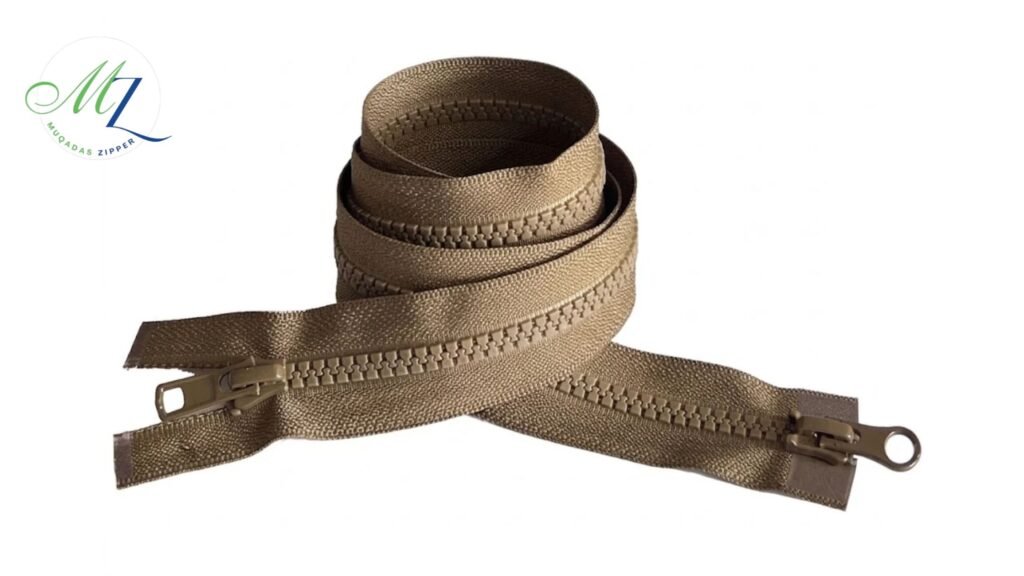
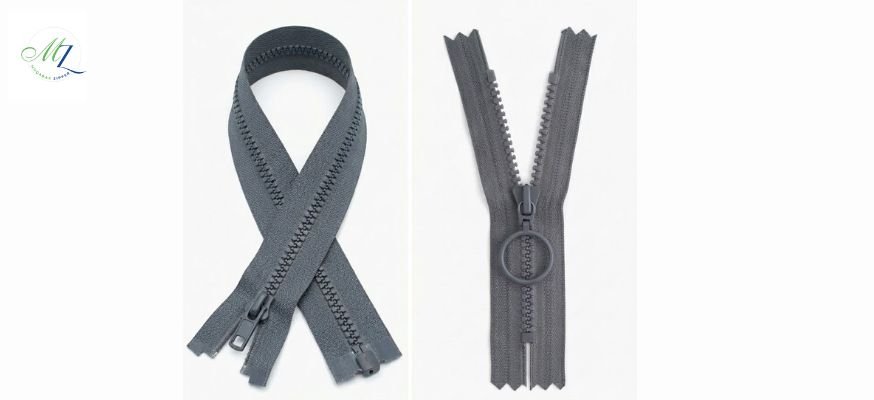
An open-end Vislon zipper separates completely into two halves, because its bottom end has an insertion pin and retainer box instead of a fixed stop. A closed-end Vislon zipper stays joined at the bottom by a permanent bottom stop, so it only opens partway. Both use the same molded plastic teeth, the same tape and the same gauge sizes. The end construction is the only structural difference, but it decides where you can use the zipper, how you measure it, how much it costs and how you order it.
In this guide, you will see how each type is built, which products need which, the specification mistakes that cause rejected batches, and exactly what to tell your zipper manufacturer when you order in bulk.
Open-End vs Closed-End Vislon Zippers at a Glance
If you only need the headline differences, this table covers them. The sections below explain each row.
| Feature | Open-end Vislon zipper | Closed-end Vislon zipper |
|---|---|---|
| Bottom construction | Insertion pin on one tape, retainer box on the other, usually with reinforced tape ends | One fixed bottom stop that joins both tapes |
| How it opens | Fully, into two separate halves | Partially; the two sides stay connected |
| Slider options | One-way or two-way | One-way or two-way |
| Typical products | Jacket and coat fronts, hoodies, detachable hoods and linings, removable panels | Pockets, pouches, bags, backpacks, luggage compartments, cushion covers |
| Main wear point | The pin-and-box joint, because you engage it every time you close the zipper | The top stops and slider |
| Length flexibility | Must be ordered at the finished length | More forgiving; easier to standardise and stock |
| Relative unit cost | Usually higher, because of extra components and reinforcement | Usually lower |
What Makes a Zipper a Vislon Zipper?
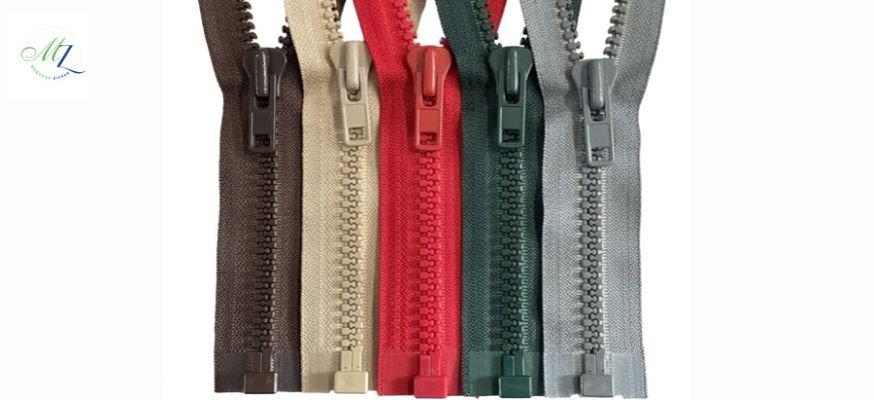
A Vislon zipper is a molded plastic zipper: individual teeth made of polyacetal (POM) resin are injection-molded directly onto a polyester tape. That is different from a coil zipper, where a continuous nylon spiral is stitched to the tape, and from a metal zipper, where metal teeth are clamped on. Molded teeth give you a chunky look, smooth glide and no rust, which is why you see them on outerwear, sportswear, bags and outdoor gear.
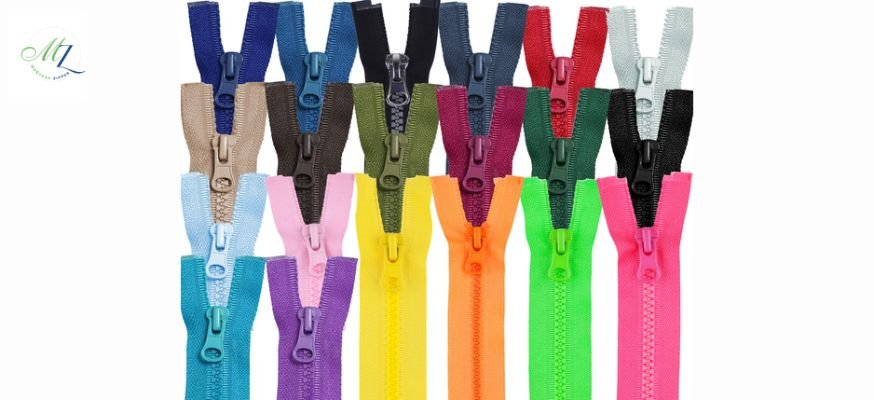
The important point for this comparison is that the chain itself is identical in both versions. When you look at our Vislon zipper range, the #3, #5, #8 and #10 gauges, the tooth colours and the slider styles are available whether the zipper ends open or closed. You are choosing an end type on top of a chain, not choosing between two different zippers.
How an Open-End Vislon Zipper Works
An open-end Vislon zipper, also called a separating zipper, has three parts at the bottom that a closed-end zipper does not:
- Insertion pin: a rigid plastic bar molded onto the end of one tape. You slide it through the slider and into the box to start closing the zipper.
- Retainer box: a molded housing on the end of the other tape. It holds the pin in place and stops the slider from running off the chain.
- Reinforcement at the tape ends: a stiffened section of tape (often a laminated film) where the pin and box are fixed, so the tape does not fray or tear under repeated insertion.
To close the zipper, you seat the pin fully in the box and then pull the slider up. If the pin is not fully seated, the teeth engage out of step and the zipper splits from the bottom. That is the most common complaint from end users, and it is a handling issue rather than a chain defect.
Because you engage the pin and box every single time you close the garment, this joint carries more repeated stress than any other part of the zipper. That is why open-end zippers need good reinforcement and a gauge that suits the weight of the garment.
Separating zipper types: one-way and two-way open-end
Open-end zippers come in two configurations, and choosing between them is a design decision, not just a cost decision.
- One-way open-end: a single slider that opens from the top down and separates at the bottom. This is the standard choice for hoodies, track jackets, windbreakers and most short to mid-length outerwear.
- Two-way open-end: two sliders on the same chain. You can open the zipper from the bottom while the top stays closed, which gives more room when the wearer sits, drives or cycles. It is the right choice for long parkas, winter coats and long robes, but it adds cost you do not need on a short jacket.
How a Closed-End Plastic Zipper Works
A closed-end plastic zipper has top stops at the head of the chain and a single bottom stop that joins both tapes. The slider can open the zipper down to that bottom stop, but the two sides never separate. Nothing at the bottom needs to be inserted, so the zipper is simpler to sew in and simpler for the end user to operate.
Closed-end zippers also come in two configurations:
- One-way closed-end: one slider, one direction. Use it for pockets, pouches, pencil cases, cushion covers and smaller bag openings.
- Two-way closed-end: two sliders on a chain that is closed at both ends. This is the familiar layout on backpacks, sports bags and luggage, where you want to open the compartment from either side. When you order it, tell your supplier whether the sliders should meet in the middle or start back to back, because that changes how the opening behaves.
In a finished product, the bottom stop of a closed-end zipper is usually sewn into a seam or a bag corner. That protects it and makes the closed-end zipper the lower-maintenance option wherever full separation is not needed.
Which One Does Your Product Need? A Three-Question Test
You can settle most specification decisions with three questions, asked in this order:
- Does the product have to come apart into two pieces? If the wearer needs to put it on like a jacket, or a hood, liner or panel has to detach, you need an open-end zipper. Nothing else will do the job.
- Is the bottom of the zipper enclosed in a seam or corner? If yes, and the answer to question 1 was no, choose a closed-end zipper. A separating bottom that is sewn shut adds cost and a joint you will never use.
- Does the user need to open it from the bottom or from either end? If yes, choose the two-way version of whichever family question 1 pointed you to: two-way open-end for long coats, two-way closed-end for bags and luggage.
The table below applies that test to common products. The gauge column is a typical starting point; your fabric weight and the load on the zipper decide the final size, so read our guide to choosing the right Vislon zipper size and tooth profile before you lock it in.
| Product | End type and sliders | Typical gauge | Why |
|---|---|---|---|
| Hoodie, track jacket, windbreaker | Open-end, one-way | #5 | Must separate to put on; length is short enough for one slider |
| Long parka or winter coat | Open-end, two-way | #5 to #8 | Separates fully, and opens from the bottom for sitting and walking room |
| Detachable hood or inner liner | Open-end, one-way | #3 to #5 | The two parts must come fully apart |
| Jacket chest or side pocket | Closed-end, one-way | #3 to #5 | Bottom is sewn into the pocket; no need to separate |
| Backpack main compartment | Closed-end, two-way | #5 to #8 | Opens from either side; both ends are sewn into the bag |
| Large sports or travel bag | Closed-end, two-way | #8 to #10 | Heavy load across a long opening; ends protected in corners |
Common Specification Mistakes and How to Avoid Them
Most problems with Vislon zippers on the production floor come from the specification, not the zipper. Watch for these:
- Closed-end on a jacket front. The garment can only be pulled over the head. It sounds obvious, but it happens when a tech pack says “Vislon #5, 60 cm” and leaves out the end type.
- Open-end where nothing needs to separate. On a bag pocket, you pay for a pin and box you will never use, and if the pin works loose the pocket cannot be closed again.
- Pin side not stated. The insertion pin can sit on the left or the right tape, and conventions differ between markets and between menswear and womenswear. State the pin side on your tech pack so the whole batch matches your garment.
- Wrong length measurement. Measure every zipper fully closed. For an open-end zipper, measure from the top of the slider to the bottom of the retainer box. For a closed-end zipper, measure from the top of the slider to the bottom of the bottom stop. In both cases, leave out the plain tape that extends beyond the teeth. If you are building a size set, our guide to calculating your zipper requirements with a manufacturer walks you through allowances and quantities.
- Too light a gauge on heavy outerwear. On an open-end zipper, the pin-and-box joint takes the most force. A heavier gauge and good tape reinforcement make a bigger difference here than anywhere else. You can read more about what affects Vislon zipper durability in everyday use.
How the End Type Changes Bulk Ordering and Cost
The end type also changes how you plan a wholesale order. Because an open-end zipper cannot be shortened from the bottom, you usually need a separate finished length for each garment size. A jacket in five sizes may need five different zipper lengths, each counted and packed separately. Closed-end zippers are easier to standardise across products and easier to hold as stock.
A simple way to plan quantities for open-end zippers is:
Zippers to order for each length = garments in that size × zippers per garment + your agreed spare allowance
Add up the lines for every length and you have the order. Agree the spare allowance with your production team before you send the purchase order, so it is not added twice.
When you send your requirement to a wholesale zipper supplier, include these details so the sample and the bulk run match. If you are new to buying in volume, our guide to sourcing plastic zippers from a zipper supplier covers the rest of the process.
- End type: open-end or closed-end
- Slider configuration: one-way or two-way, and for two-way closed-end, whether the sliders meet in the middle or start back to back
- Gauge: #3, #5, #8 or #10
- Finished length for each size, and how you measured it
- Tape colour and tooth colour, ideally with a fabric swatch
- Slider type (auto-lock or non-lock) and puller style, including any logo puller
- Pin side for open-end zippers
- Quantity for each length
At Muqadas Zipper, we produce Vislon zippers in #3 to #10 in closed-end, open-end and two-way formats at our Lahore facility. If you are unsure which end type suits a new product, request samples of both and test them on the actual garment or bag before you approve the bulk order. A pin that seats easily on the bench can behave differently once it is sewn into a thick quilted coat.
Frequently Asked Questions
Can you turn a closed-end zipper into an open-end zipper?
No. An open-end zipper needs an insertion pin, a retainer box and reinforced tape ends that are built in during manufacturing. You cannot add them to a closed-end zipper afterwards, so order the correct type from the start.
Can you use an open-end zipper in place of a closed-end one?
Technically yes, if you sew the separating bottom into a seam. It works, but you pay for parts you will not use, so in bulk production a closed-end zipper is the better choice wherever separation is not needed.
Is an open-end Vislon zipper weaker than a closed-end one?
The chain strength is the same, because both use the same molded teeth and tape. The difference is that the open-end zipper has an extra wear point at the pin and box. With the right gauge and good reinforcement, that joint holds up well on everyday outerwear.
Can you shorten an open-end Vislon zipper?
Only from the top, because the pin and box are fixed at the bottom. That means removing molded teeth and fitting new top stops, which is slow work on a production line. It is far more efficient to order each size at its finished length.
Choosing Between Open-End and Closed-End Vislon Zippers
Start with your product list and run each item through the three-question test: does it need to separate, is the bottom enclosed, and does it need to open from either end. Write the answer, the gauge, the finished lengths and the pin side into your tech pack, then request samples so you can test the pin, the slider and the colour match on the real product. Once the sample is approved, your bulk zipper supplier has everything needed to deliver a batch that matches it.